
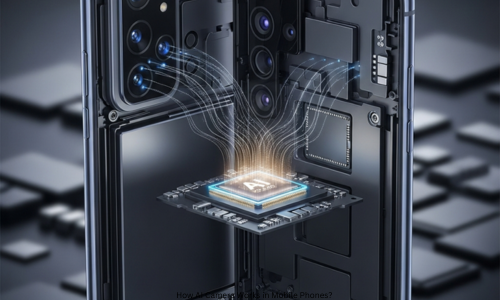
How AI Camera Works in Mobile Phones? Remember the old days of digital cameras? You pointed, pressed, and crossed your fingers. Poor light turned photos into dark, fuzzy messes. Anyone who moved showed up like a ghost. Fast forward. You pull out your phone, take a picture in a dim restaurant, and it comes out bright and sharp. You snap a portrait and the background melts into a smooth, creamy blur, like a studio shot.
How does that happen? Is your phone lens suddenly better than a bulky camera? Not really. The trick isn’t only the glass. It’s a quiet, powerful intelligence running behind the scenes. This is AI in mobile cameras. How AI Camera Works in Mobile Phones?
Asking “how does an AI camera work in a mobile?” isn’t asking about new hardware. It’s about new software and fast processing. It turns your phone from a simple light-catcher into a smart image computer. Let’s pull back the curtain and look at the pieces. How AI Camera Works in Mobile Phones?
Part 1: The Fundamental Shift – What an “AI Camera” Really Is
First, an “AI Camera” isn’t a special lens. It’s the result of three parts working together:
- The Camera Hardware: Lens, image sensor, and optics capture raw light and color.
- The Specialized Processor (NPU): Modern chips include a Neural Processing Unit. It runs AI tasks fast and power-efficiently.
- The AI Software (The Magic): Machine learning models analyze the image in real time and make smart fixes.
Think of the sensor as the eye and AI as the brain. The eye sees raw data. The brain reads it, understands it, and decides what matters. How AI Camera Works in Mobile Phones? This approach is called Computational Photography. The final photo is no longer a simple snapshot. It’s a computed, improved version of reality.
Part 2: The AI Toolkit – The Specific Jobs AI Performs
What does the AI brain actually do? It is a toolbox of functions that run in milliseconds before, during, and after you press the shutter. How AI Camera Works in Mobile Phones?
1. Scene Recognition: The Smart Director
How it works: Before you shoot, the AI studies the live view. It learned patterns from millions of images. It can identify what you’re pointing at in an instant. How AI Camera Works in Mobile Phones?
What it does: The AI labels the scene: landscape, food, pet, or face at night.
The result: The phone auto-applies the best settings.
- Food: Boosts saturation and warmth to make the dish pop.
- Landscape: Raises contrast and sharpness for more punch.
- Portrait: Keeps skin tones true and locks focus on the face.
- Sunset: Enhances warm oranges and reds.
You don’t tweak settings. The AI picks them like a pro. How AI Camera Works in Mobile Phones?
2. Portrait Mode & Semantic Segmentation: The Digital Artist
How it works: In Portrait Mode the AI does semantic segmentation. It separates the subject from the background and maps depth.
What it does: The subject stays sharp while the background gets a natural-looking blur. Advanced models trace hair strands for cleaner edges. How AI Camera Works in Mobile Phones?
The result: A portrait that mimics the shallow depth-of-field of an expensive lens, all done by software. How AI Camera Works in Mobile Phones?
3. Night Mode: Conquering the Darkness
How it works: Night Mode uses a burst of shots at different exposures, not one long exposure.
What the AI does:
- Alignment: It lines up frames and corrects for hand shake.
- Noise Reduction: It strips grain from dark areas without blurring detail.
- Merging (Stacking): It blends the best parts from each frame into one image.
The result: A bright, detailed photo taken where phones used to fail.
4. Smart HDR: Balancing Light and Shadow
How it works: Shooting a person against bright sky creates trouble. HDR takes several shots at different exposures: under, normal, and over. How AI Camera Works in Mobile Phones?
What the AI does: The AI blends the shots, picking the best sky, the best face, and the best mid-tones.
The result: One balanced photo that keeps sky color and face detail.
5. AI Beautification and Face Retouching
How it works: The AI learns facial features eyes, nose, mouth, chin, and skin texture. How AI Camera Works in Mobile Phones?
What it does: It can smooth skin, remove blemishes, brighten eyes, or tweak face shape.
The result: A polished selfie that fits certain beauty styles. It’s powerful but can spark debate.
Part 3: The Engine Room – The Technology Powering the AI
How does a small phone do so much so fast? The secret is special chips and smart models.
The Hardware: The NPU (Neural Processing Unit)
The phone’s CPU is a generalist. It would be slow and hungry for battery doing heavy AI math.
Modern chips, like Apple’s Bionic or Google’s Tensor, include an NPU. The NPU runs matrix math extremely fast and uses little power. It can do trillions of operations per second. The NPU makes real-time AI work on phones. How AI Camera Works in Mobile Phones?
The Software: Machine Learning Models
The AI’s smarts come from trained machine learning models. Before the phone ships, engineers feed these models millions of labeled photos, like “this is a cat,” “this is a face,” or “this is a sunset.” The model learns the patterns, textures, and shapes tied to each label. When you point the camera, the model compares the live view to what it learned and decides how to process the image. How AI Camera Works in Mobile Phones?
The Future is Even Smarter
AI in phone cameras is only just beginning to reshape how photos get made. Cameras will become predictive and creative, not just assistive tools. How AI Camera Works in Mobile Phones?
- AI-Powered Video: Imagine real-time Portrait Mode for video, letting you change focus after recording.
- Generative AI: Edit photos with simple text commands, like remove people in the background or change the sky to a golden sunset. Google’s Magic Editor is an early example.
- Predictive Capture: AI could analyze motion and snap photos before you press the shutter, catching the perfect moment.
- Hyper-Personalization: The system will learn your style and start suggesting edits and shots that match your taste. How AI Camera Works in Mobile Phones?
Conclusion
Your Smartest Photography Companion An AI camera on a phone is more than a lens and sensor; it’s an imaging computer. Powerful AI software runs on a dedicated NPU, analyzing scenes and rebuilding them into better images. It acts like an expert choosing settings, an editor balancing light, and an artist shaping portraits. High-quality photography is now accessible to many, placing creative power in your pocket. How AI Camera Works in Mobile Phones? Next time a phone shot looks stunning, remember the quiet AI working behind the scenes.
Frequently Asked Questions (FAQ)
Is “AI Camera” just a marketing buzzword, or is it a real technology?
Both apply. The term sells phones, yet the tech behind it computational photography is real and powerful. Features like Night Mode, Portrait Mode, and automatic scene tuning rely on AI models running on the phone.
Does the AI camera need an internet connection to work?
Mostly no; core AI processing runs on-device using a phone’s NPU and optimized chip. Scene recognition, HDR, and portrait effects compute locally in milliseconds. Some heavy generative features, like Google’s Magic Editor, send photos to cloud servers for extra work. But most everyday shooting needs no internet at all.
Is my phone’s AI sending my private photos to a server? What about my privacy?
Privacy is serious. Most AI camera work stays on-device and photos are not uploaded with every shot. Cloud risks rise when users enable cloud backups or cloud-based editing that states it needs server processing. Normal point-and-shoot photos remain private on the device.
Can the AI make mistakes? What happens then?
Yes. AI can make errors. Examples include portrait blurs, wrong scene labels, and over-softened skin from beauty modes. Bad results can look odd, but models improve with updates and new phones.
Can I turn the AI off?
I prefer to have full manual control. You can avoid most automatic choices by using Pro or Manual mode in the camera app. Pro mode gives control over ISO, shutter speed, white balance, and manual focus. Shooting RAW captures sensor data with minimal processing, so edits bypass the phone’s AI choices.
Is the AI the same on an iPhone, a Google Pixel, and a Samsung phone?
No, the AI differs across brands due to different hardware, software, and tuning choices. Google Pixel favors machine-learning methods, giving realistic, detailed HDR and Night Sight results. Apple focuses on natural looks via its Neural Engine, Photonic Engine, and Deep Fusion tools. Samsung often pushes vivid, social-ready images with strong color and many modes. Which is best depends on personal taste.
Do I need to buy a new, expensive phone to get a good AI camera?
Top AI features tie to the processor and NPU, so newer phones usually perform better. Faster chips run complex AI tasks more accurately, improving Night Mode performance, portrait cutouts, and real-time video effects.
1 thought on “How AI Camera Works in Mobile Phones?”