
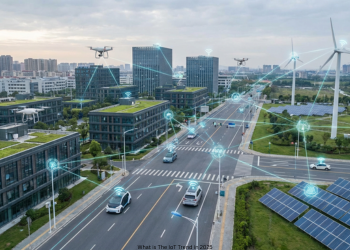
What is The IoT Trend in 2025? The Internet of Things (IoT) has drawn attention for years. It links to smart speakers that play music or watches that track steps. People now expect these first connected tools. They let us manage our space through apps or voice orders. A big change heads for 2025. Talk no longer centers on linking more items. It focuses on smart links. IoT then stresses need over fun. It favors forecast and self-rule over orders and replies. What shapes IoT in 2025? A strong mix of tech and business forces builds an smart linked world. These shifts move IoT from daily edges to core roles in work, health care, and green growth. Now examine the five main IoT shifts for 2025.
Trend 1: Growth of Smart Edge (AIoT)
Early IoT devices just gathered data. They felt the world and shipped it to the cloud for work. This setup faced key limits. It caused delays and ate bandwidth. By 2025, this flips with wide use of Smart Edge, or AI of Things (AIoT). What is The IoT Trend in 2025?
- What It Means: AIoT puts AI work right on the device. A camera skips raw video sends to cloud. It checks the video on site. Thought occurs at the network’s edge.
- Why This Time? Strong, low-power AI chips (NPUs) allow hard learn tasks on tiny devices.
In 2025, It Shows As:
- Stores: A shop camera tracks buyer paths live. It spots top displays and flags low stock. Staff gets notice. No cloud send keeps buyer video private.
- Factory Work: A robot arm’s built-in camera spots bad parts fast. It pulls them off line. Cloud links fail at this speed.
- Home Guards: A door cam sorts mail drops, known faces, pets, or threats on device. Alerts grow clear and helpful.
Effects: AIoT speeds systems, boosts trust, and cuts cloud needs. Local work lifts privacy. What is The IoT Trend in 2025?
Trend 2: Digital Twins Spread Wide
Digital Twins stayed high-end for years. Big air and factory firms used them. By 2025, they turn common and key in more fields.
- What It Means: A Digital Twin copies a real item, flow, or setup in virtual form. Sensors on the real feed live data to the twin. It matches true state and acts. What is The IoT Trend in 2025?
- Why This Time? Low-cost sensors, strong cloud power, and AI sims ease setup and care.
In 2025, It Shows As:
- Office Towers: A building lead views its full twin model. They check energy use live, spot bad heat units early, and test temp shifts on costs.
- City Roads: A town twins its traffic net. Planners test road blocks, events, or bus adds to cut jams ahead.
- Car Builds: Makers feed road car data to model twins. They track part wear and build tougher next ones.
Effects: Twins join real and virtual. They aid fix-ahead care, lift output, and test safe. What is The IoT Trend in 2025?
Trend 3: Health Care Turns Ahead (IoMT)
COVID sped the Internet of Medical Things (IoMT). By 2025, care moves past far talks to steady, ahead, and fit-to-you health.
- What It Means: IoMT ties wearables, body sensors, and home kits to watch signs and health data non-stop outside hospitals.
- Why This Time? Telehealth grows liked. True med wearables improve. Insurers pay more. 5G brings steady high-speed links for live data.
In 2025, It Shows As:
- Home from Hospital: Post-op patients take kits with blood cuffs, oxygen checks, and scales. Nurses watch clouds for alerts on bad signs.
- Sugar Watch: A diabetes tracker’s glucose data joins a net. AI spots low-sugar risks from moves and food. Warnings come early. What is The IoT Trend in 2025?
- Mind Health: Wearables check heart shifts, sleep, breath for stress signs. They nudge calm acts or doc links.
Effects: IoMT changes care from fix to stop ills. It cuts return stays and aids self-care. What is The IoT Trend in 2025?
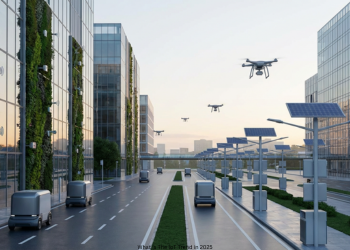
Trend 4: Cybersecurity Takes Center Stage with a “Zero-Trust” Model
As the number of connected devices balloons into the trillions, the potential “attack surface” for hackers becomes terrifyingly large. One vulnerable smart camera might be the gateway into an entire corporate network. By 2025, IoT security will no longer be an afterthought; it will be a foundational design principle.
- What It Is: The “Zero-Trust” security model represents a paradigm shift. Where the old model was “trust but verify” in its assumption that everything inside a network was safe, Zero-Trust is based on the principle of “never trust, always verify.” Every device and user attempting to access a resource on the network must be authenticated and authorized-whether inside or outside the network perimeter.
- Why Now? A spate of high-profile IoT-based cyber-attacks has made painfully clear the fact that the old security models are inadequate. What is The IoT Trend in 2025?
What It Looks Like in 2025:
- Smart Factories: Every sensor, every robot, every controller on the factory floor will have its own unique identity. No two devices can talk to each other before they mutually authenticate. In case any single sensor gets compromised, it will be instantly isolated and unable to affect the rest of the network.
- Connected Vehicles: A car’s critical systems-such as its brakes and engine control-will be on a hyper-secure, isolated network. The infotainment system, which will have a connection to the internet, will be treated as an untrusted device, required to go through layers of verification to communicate any information to the car’s core functions.
Impact: A Zero-Trust architecture makes IoT systems resilient to attack, contains breaches, and protects critical infrastructures along with sensitive data. What is The IoT Trend in 2025?
Trend 5: IoT for ESG: The Sustainability Imperative
With increasing global pressure on companies to meet ESG goals, IoT is emerging as arguably the most powerful single tool to achieve these goals. By 2025, demonstrating sustainability will be integral to core business drivers, and IoT will provide the data to make that happen.
- What It Is: IoT sensors and platforms are being deployed to measure, monitor, and optimize resource usage, reduce waste, and decrease carbon emissions.
- Why Now? Regulatory requirements, investor pressure, and consumer demand are forcing companies to move beyond vague promises and provide hard data on their sustainability efforts. IoT is the key to gathering that data. What is The IoT Trend in 2025?
What It Looks like in 2025:
- Smart Grids: Utility companies will utilize IoT sensors throughout the power grid to balance energy loads in real time with seamless integration of renewable energy sources such as wind and solar, and drastically reduce energy loss.
- Precision Agriculture: Farms will deploy drones and soil sensors to apply water and fertilizer with pinpoint accuracy, only where and when it’s needed. This will conserve massive amounts of water and prevent chemical runoff into rivers.
- Supply Chain Transparency: IoT trackers on products from source to shelf will provide a verifiable record of a product’s journey, letting companies prove their materials are ethically sourced and that their carbon footprint is minimized.
The Impact: IoT provides the tangible, data-driven evidence needed to turn sustainability goals into measurable actions, making it a critical tool for corporate responsibility and combating climate change. What is The IoT Trend in 2025?
Conclusion: The Intelligent Weave
The trend of IoT in 2025 is a story of convergence: AI meeting the edge, the physical meeting the digital twin, and connectivity meeting the critical needs of healthcare and sustainability, all wrapped in a new blanket of cybersecurity. We’re moving from a world where we command our devices to a world where our devices anticipate our needs. The technology is becoming less visible but more vital, weaving itself into an intelligent fabric that underpins our industries and enhances our lives. In 2025, the question for businesses and people is no longer if they will be part of this connected world but how they will harness its growing intelligence. What is The IoT Trend in 2025?
Frequently Asked Questions
How does ‘Intelligent Edge’ – AIoT – affect my privacy? Is it better or worse than the cloud?
That is a critical question, and the answer is surprisingly positive. In many ways, counterintuitively, the rise of the Intelligent Edge is a quantum leap forward for user privacy compared with the traditional cloud-based model.
Traditional IoT (Cloud-based): A smart camera in your home captures video, sends the raw video stream across the internet to a server in the cloud, where it is then analyzed. Your private video data leaves your home. What is The IoT Trend in 2025?
Edge-based AIoT: The smart camera contains an AI chip inside. It analyzes the video feed locally on the device itself. It determines “human detected” or “package delivered” and only sends that tiny, anonymous piece of text data-the result of the analysis-to the cloud for the alert. The sensitive raw video never has to leave your home network.
While no system is perfectly secure, AIoT minimizes the amount of personal data being transmitted and stored on third-party servers, fundamentally enhancing privacy. What is The IoT Trend in 2025?
Are Digital Twins only for huge corporations, or will we see them in smaller businesses by 2025?
While Digital Twins started in massive industries, such as aerospace, by 2025 they will be considerably more accessible to small and medium-sized businesses. The key is the “as-a-service” model.
Instead of building a complex Digital Twin system from scratch, SMBs will be able to subscribe to Digital Twin platforms. For instance, a small logistics company would make use of a service to create Digital Twins of its delivery vans to monitor fuel efficiency and predict maintenance needs. A small-scale farm could subscribe to a platform that creates a Digital Twin of its field to optimize irrigation. The high upfront cost is replaced with a more manageable monthly subscription, democratizing this powerful technology. What is The IoT Trend in 2025?
With the rise of proactive health care-IoMT, will AI replace doctors and nurses?
No, it is not IoMT’s goal to replace healthcare professionals but to empower them. It automates the repetitive and information-intensive tasks, freeing the doctors and nurses to do what humans do best: complex decision-making, patient interaction, and empathetic care. What is The IoT Trend in 2025?
Think of it this way: AI and IoMT can monitor a patient’s vital signs 24/7-a task no human nurse can do. The AI can flag a potential issue in the data. But it will be the human doctor who looks at the alert, considers the patient’s full medical history and unique context, and decides on the best course of action. IoMT turns healthcare professionals into data-informed experts, not obsolete workers. What is The IoT Trend in 2025?
What does ‘Zero-Trust’ security model mean for the average user? Will it make my smart home more complicated?
A well-implemented Zero-Trust model should be nearly invisible to users and truly simplify your smart home while keeping it safer. The intricacies happen in the background. What is The IoT Trend in 2025?
Today, you might need different apps and complex rules to make sure your devices are secure. In a Zero-Trust future, security is built-in. When you add a new “Matter-certified” smart light, it will automatically and securely authenticate itself to your network. It will be granted the absolute minimum permissions it needs to function, such as permission to be turned on/off, but not to access your smart speaker. You won’t have to do anything extra, yet you’ll benefit from a system where even if one device gets compromised, it is automatically isolated and can’t harm the rest of your network. What is The IoT Trend in 2025?
According to Trend 5, IoT will help sustainability, but won’t manufacturing billions of new devices create more e-waste?
This is a critical paradox and one at which the industry is actively working to solve. The answer is twofold
Net Positive Impact: A core principle is that any savings enabled by an IoT system should be significantly more than the resources needed to build and operate it. For instance, the energy saved by a smart grid over its 20-year lifetime is projected to be many thousands of times greater than the energy required to manufacture its sensors. What is The IoT Trend in 2025?
The Circular Economy: By 2025, sustainable hardware design will have a much greater impetus. This refers to the development of IoT devices that are modular, thereby easy to repair and upgrade; built with recycled materials; and straightforward to dismantle at the end of their life so that their parts can be reused. The movement on “right to repair” will also drive manufacturers to design and build more robust devices that are less disposable. What is The IoT Trend in 2025?
Which of these 2025 trends will have the largest impact on daily life for the average person?
Of these, the IoMT trend in proactive healthcare will probably be the most personally impactful to the average individual. Smart cities and smart factories are indeed transformative, but they often operate in the background.
The IoMT trend directly touches upon our personal well-being and that of our families. Whether it’s the capacity to have early warnings on heart conditions on your smartwatch, an elderly parent to live more safely at home with remote monitoring, or a diabetic child whose condition is managed more smoothly-these are deeply personal applications that change lives in meaningful ways and will be directly witnessed by many people by the year 2025. What is The IoT Trend in 2025?
With IoMT and proactive health care, who owns my health data: me, my doctor, or the device company?
Data ownership is one of the most hotly debated topics in tech ethics. In 2025, the legal and ethical framework will be on its way toward a model whereby you, the patient, are the ultimate owner of your data.
You will give access to your doctor, hospital, or a monitoring service but you retain rights to see that data, to share it with another provider, and to revoke access. Regulations like GDPR have already established this principle. Device companies are seen as “data custodians” rather than owners. They will be legally responsible for securing your data but they will not have the right to use it without your explicit consent. What is The IoT Trend in 2025?
What is the main difference between AIoT and the “AI in the cloud” that we have today?
The key difference is the location.
AI in the Cloud: The device is “dumb.” It captures data and sends it to a powerful server far away; the thinking happens on the server. What is The IoT Trend in 2025?
AIoT Intelligent Edge: The device itself is “smart.” It contains an AI chip. The thinking occurs on the device itself.
This shift in locale has three enormous advantages: Speed-a decision is made in an instant, Reliability-it works without an internet connection, and Privacy-sensitive data need not leave the device. What is The IoT Trend in 2025?
What kind of skills or jobs are going to be in demand with these new IoT trends?
With this shift in IoT, there is a huge demand for new skill sets. Some of the highly sought-after jobs will include the following:
IoT Security Specialist: Experts in network security and the implementation of Zero-Trust architectures.
AI/ML Engineers-Edge Focus: Individuals capable of designing and optimizing machine learning models to run on low power devices. What is The IoT Trend in 2025?
Data Scientists: Analyzing large volumes of data from IoT systems and obtaining useful insight from it. Digital Twin Architects: Engineers who can design, build, and manage complex virtual replicas. Robotics and automation technicians will be skilled individuals who can keep up and repair the physical components of the IoT world: robots, drones, sensors. 10. Realism of this vision for 2025: Is this hype or is it real and being implemented now? This vision is very realistic; these are not futuristic predictions, but rather accelerations of trends already in implementation today. AIoT: The latest smartphones and smart cameras already have powerful AI chips for on-device processing. Digital Twins: Already being utilized by companies like Boeing and Siemens, the techno. What is The IoT Trend in 2025?
1 thought on “What is The IoT Trend in 2025?”