
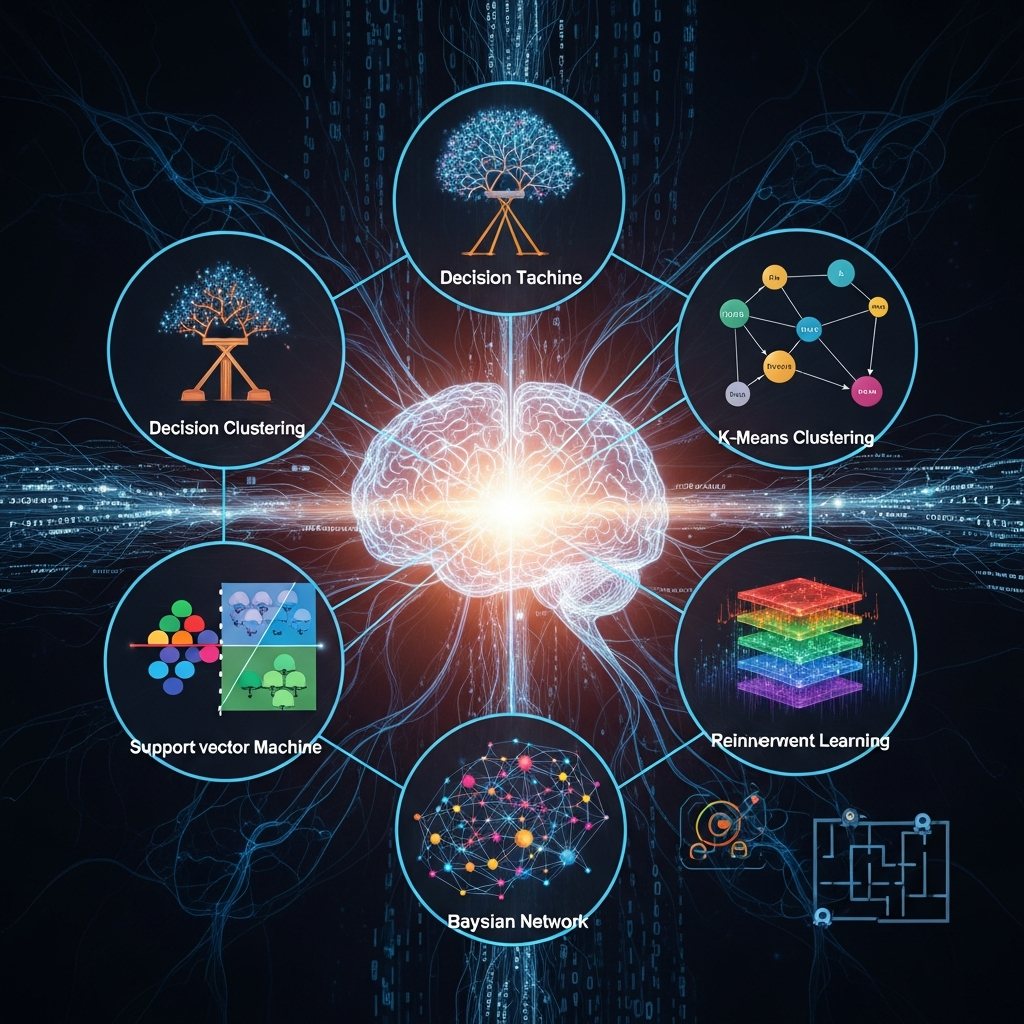
Types of Machine Learning Algorithms. Machine learning (ML) ranks as a top technology today. It drives custom suggestions on streaming sites, catches fraud in banks, and aids disease checks in health care. These algorithms shape daily life without fanfare. Various types power these smart tools. Each type fits certain data problems.
Students, researchers, developers, and business pros need to grasp these algorithm types. Each group uses a unique learning style, handles data its own way, and fits real tasks. This blog post covers main ML algorithm types. We describe their ideas, traits, strengths, weaknesses, and real uses.
What Is Machine Learning?
Machine learning forms part of AI. It lets computers learn from data and get better over time. No need for step-by-step code. ML spots patterns in data. It uses them for guesses or choices. Types of Machine Learning Algorithms.
Algorithm choice shapes ML success. Algos learn in varied ways. So experts sort ML into types by training methods and data use.
Why Different Types of Machine Learning Algorithms?
Problems differ. Data sets vary too. Some data has labels. Others lack them. Tasks might predict numbers, sort items, or guide choices. These gaps lead to types for key learning needs.
Main types include:
- Supervised Learning
- Unsupervised Learning
- Semi-Supervised Learning
- Reinforcement Learning
Each type holds many algos for set tasks.
Supervised Learning Algorithms
Supervised learning sees wide use in ML. The algo trains on data with labels. Each input pairs with a known result. It links inputs to outputs. Then it predicts for fresh data. Types of Machine Learning Algorithms.
Key Traits of Supervised Learning
- Needs labeled data
- Has a clear goal variable
- Hits high marks with good data
- Fits many real jobs
It shines due to clear results and solid predictions.
Supervised Learning Problem Types
Two main kinds exist:
Classification
These algos predict labels or groups. Think spam filters, illness checks, or mood reads. Types of Machine Learning Algorithms.
Regression
These predict steady numbers like home costs, weather temps, or sales totals.
Common Supervised Learning Algorithms
Linear Regression
This basic algo links inputs to number outputs with a straight line. Simple yet key in money fields, finance, and forecasts.
Logistic Regression
It fits two-choice tasks. It gauges odds of a class like yes/no or true/false. Types of Machine Learning Algorithms.
Decision Trees
They split data by rules in tree form. Easy to see and grasp. Big in business and data checks.
Random Forest
This method blends many trees. It boosts accuracy and cuts errors. Strong for sorting and number tasks.
Support Vector Machines (SVM)
SVMs draw the best line to split classes. They excel in big data spaces. Common for text sorts and image IDs. Types of Machine Learning Algorithms.
k-Nearest Neighbors (KNN)
KNN sorts points by closest matches. Simple idea. Slow on huge data sets.
Unsupervised Learning Algorithms
These algos use data without labels. No known outputs up front. They hunt for hidden links, groups, or ties in data. Types of Machine Learning Algorithms.
Key Traits of Unsupervised Learning
- Lacks output labels
- Seeks patterns
- Aids data probes
- Suits start of analysis
It helps most when labels cost too much or miss.
Unsupervised Learning Task Types
Clustering
Groups like items by traits.
Association
Finds ties and rules in data. Key for shopping basket checks.
Dimensionality Reduction
Cuts features but keeps main info. Eases views and checks. Types of Machine Learning Algorithms.
Common Unsupervised Learning Algorithms
K-Means Clustering
Top pick for groups. Splits data into set cluster counts by likeness. Fits customer splits and image shrinks.
Hierarchical Clustering
Builds layered groups like a tree. No need for cluster count. Good for small data ties.
DBSCAN
This clusters by density. Spots odd points and odd shapes well.
Principal Component Analysis (PCA)
Cuts data to few key traits. Keeps most changes. Types of Machine Learning Algorithms.
Apriori Algorithm
Mines rules from common sets. Used in stores for buy suggestions.
Semi-Supervised Learning Algorithms
This blends labeled and unlabeled data. Labels cost a lot but unlabeled piles up. It mixes both for better results.

Key Traits of Semi-Supervised Learning
- Small labeled set
- Big unlabeled set
- Beats pure unsupervised accuracy
- Cuts label needs
Great for scans in medicine and text work.
How Semi-Supervised Learning Works
Model starts with labels for base grasp. It scans unlabeled data for patterns. Predictions sharpen step by step. Types of Machine Learning Algorithms.
Common Semi-Supervised Learning Techniques
Self-Training
Train on labels. Guess for unlabeled. Retrain on sure guesses.
Co-Training
Two models use data views. Each aids the other.
Graph-Based Methods
Data forms graphs. Labels spread via like-point links.
Reinforcement Learning Algorithms
Reinforcement learning draws from behavioral psychology. An agent learns in this machine learning approach by acting in an environment. It gets rewards or penalties for each action. Types of Machine Learning Algorithms.
Key Traits of Reinforcement Learning
- Trial and error to learn
- Feedback from rewards
- No need for labeled data
- Stress on step-by-step choices
Robots, games, and self-driving systems often use reinforcement learning.
Main Parts of Reinforcement Learning
Agent: The decision maker
Environment: What the agent acts in
Action: What the agent does
Reward: Feedback from the action
Policy: The agent’s plan
Common Reinforcement Learning Algorithms
Q-Learning
Q-learning uses values to guide the agent. It picks the best action per state to boost future rewards.
Deep Q-Networks (DQN)
DQN blends deep learning with Q-learning. It tackles tough settings like video games. Types of Machine Learning Algorithms.
Policy Gradient Methods
These tune the policy straight away. They fit actions that vary smoothly.
Actor-Critic Methods
Actor-critic mixes value and policy ways. It boosts steady learning and speed.
Instance-Based Learning Algorithms
Instance-based methods keep training data. They predict by matching similar cases, not building models.
- Key Traits
- Stores data in memory
- Skips formal training
- Predicts on the spot
Examples: k-nearest neighbors, locally weighted regression.
Ensemble Learning Algorithms
Ensemble methods team up models for stronger results than one alone.
Types of Ensemble Methods
Bagging
Cuts variance with data subsets for each model.
Boosting
Fixes weak spots from past models.
Stacking
Uses a top model to blend others’ guesses.
Top ones: Random Forest, AdaBoost, Gradient Boosting.
Deep Learning Algorithms in Machine Learning
Deep learning builds on neural nets with many layers. It spots tough patterns.
Common Deep Learning Algorithms
- Artificial Neural Networks (ANN)
- Convolutional Neural Networks (CNN)
- Recurrent Neural Networks (RNN)
- Long Short-Term Memory (LSTM)
Transformers
Deep learning shines at images, speech, and language tasks.
Picking the Best Machine Learning Algorithm
Choice hinges on key factors:
- Data type
- Labeled data access
- Task hardness
- Compute power
- Needed accuracy
Knowing types aids smart picks.
Real-World Uses of Machine Learning Algorithms
These algorithms drive:
- Recommendation tools
- Fraud checks
- Health diagnoses
- Self-driving cars
- Voice recognition
- Image sorting
Each type fits industry needs.
Strengths and Weak Sides of Machine Learning Algorithms
- Strengths
- Handles hard tasks on auto
- Sharpens choices
- Grows and adjusts easy
- Weak sides
- Needs lots of data
- Risks bias and unfairness
- Hard to explain
Smart use matters for good outcomes.
The Future of Machine Learning Algorithms
Machine learning heads toward:
- Faster methods
- Clear AI explanations
- Mixed learning styles
- Teamwork with humans
Better algorithms mean wider reach and bigger effects.
Conclusion
Machine learning algorithms power today’s AI. Supervised, unsupervised, reinforcement, and semi-supervised types solve key issues. Grasping them builds a solid base for data, AI, and smart tech work. Types of Machine Learning Algorithms.
Tech keeps growing. Machine learning algorithms will shape new ideas, auto tasks, and choices worldwide.
FAQs
Q1. What does ensemble learning mean in machine learning?
Ensemble learning combines several models. This improves performance, accuracy, and strength.
Q2. What is your choice for selecting an appropriate machine learning algorithm?
Pick based on type of problem, amount of data, size, accuracy level desired, and computing power.
Q3. What are machine learning algorithms?
Computers learn patterns from data with these algorithms. They predict or decide without direct programming.
Q4. Can one algorithm solve all machine learning tasks?
False. Different problems require different types of algorithms.