

Smart Water Level Monitoring System Using IoT. For countless homeowners, farmers, and factory managers, this basic question sparks daily worry. Usually, it means a boring manual check in the form of climbing a ladder, peering into a dim tank, or waiting until the tap goes dry at the worst time. At the other end of the spectrum, an over-flowing tank makes noise, wastes water, and can be hazardous. This is an antiquated way of dealing with water: slow to respond, wasteful, and full of stress.
Imagine if your water tank could alert you. Picture the message on your phone when levels drop low. See a live meter of its full capacity from anywhere. Let it start the pump when empty and stop it when full, all on its own. This setup exists today. Smart water level monitors use IoT, in other words, the Internet of Things. It is technology that converts any ordinary tank into an intelligent and networked device. The detailed tutorial will, hence, explain what it is, the key components involved, its operation, and procedures for making your own. Smart Water Level Monitoring System Using IoT.
Part 1: Issues with Basic Water Handling
First, note the problems that it fixes: Poor water control causes real harm.
- In homes: Running out of water annoys everybody. Overflows waste water, increase bills, and damage your house. Dry pumps break easily. Water is used in farming to keep the crops alive. An empty tank at key moments ruins harvests. Too much pumping uses extra power and drains wells. Checking big fields by hand takes too long.
- In factories: Continuous water supply is important for production. A brief lack shuts down lines and is costly. One smart system solves all these with clean tech. Smart Water Level Monitoring System Using IoT.
Part 2: Components of an IoT Water Level Monitor
IoT setups look tricky, but they’re simple teams of parts. Each has one job. Here they are.
The Sensor: Water Level Detector
This forms the core. It checks water height without contact. Top pick for home or pro builds: an ultrasonic sensor, like HC-SR04.
How it runs: Simple and smart. Like a bat, it fires a quick sound wave, ultrasound. The wave hits water, echoes back. It times the echo trip, with sound speed known, it finds the distance.
Other options are pressure sensors under the water or float switches for high-low checks. Still, ultrasonic gives good accuracy with low cost and no touch. Smart Water Level Monitoring System Using IoT.
The Processor: Microcontroller
It sends raw time data from the sensor. It needs smarts for crunching numbers, running rules, and linking online. It does so with a microcontroller.
- Best pick: ESP32. For new IoT jobs, it rules. Cheap, strong chip with Wi-Fi and Bluetooth built in. One part handles brain and link duties: plenty of power for sensor reads, math, and net work. Smart Water Level Monitoring System Using IoT.
The Link: Connectivity Tool
That will need to get on the internet. ESP32 has Wi-Fi already. It joins your home net like a phone. Further out farms, try LoRaWAN or cell data. Wi-Fi works for most needs. Smart Water Level Monitoring System Using IoT.
The Hub: IoT Cloud Service
Data heads to a cloud hub: the IoT platform.
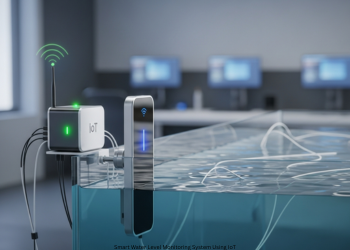
Its roles include
- Stores data: Grabs level information safely, keeps records.
Displays data by creating screens with meters, lines, and graphs to view present and past. Smart Water Level Monitoring System Using IoT.
Sends alerts: Sets rules like “low at 20%, text my phone.”
Easy starter platforms:
- Blynk: Builds sharp phone apps with drag tools.
- Arduino IoT Cloud: fits Arduino gear tight.
- ThingSpeak: Basic log and view spot.
- The Screen: Phone Application or Web Page
You use this to check in: Phone app from Blynk or browser page. It shows cloud data clear with live meters and past use.
Part 3: Data Path from Tank to Phone
Follow one reading’s journey.
1. Measure: Microcontroller cues sensor pulse. Echo returns from water.
2. Calc: Time the echo path for distance.
3. Conversion: Code knows the tank depth. Subtract distance for level. Convert to percent – example 75% full
4. Link up: Wi-Fi joins local net.
5. Send: Sending data such as {“level”: 75} to cloud.
6. Show and warn: Cloud updates your app meter. It checks rules. Low at 20%? Alert pings phone
7. Auto step: cloud commands back. Low level turns on relay for pump. Full at 95% turns it off. Full hands-free loop. Smart Water Level Monitoring System Using IoT.
Part 4: Key Wins from Smart Setup
Gains outdo just checking levels.
- Save water: stops overflows cold.
- Cut power: Pump runs only when needed.
- Guard pump: no dry runs, no big fixes
- Ease worry: Skip ladders. Spot shortages early. Check from afar.
- Identify trends: Past usage reflects utilization patterns. Locate leaks from drips. Identify peak periods. Apply facts for better planning. Smart Water Level Monitoring System Using IoT.
FAQs
Q1: What is an IoT water level monitoring system?
A smart system fitted with sensors checks the water level in a tank. An Internet device sends data across to you. You monitor the level of water on your phone, receive alerts, and auto-control the pump. Smart Water Level Monitoring System Using IoT.
Q2: How does it actually measure the water level?
It uses most often an ultrasonic sensor. The sensor sends a sound wave down. The wave hits water and bounces back. Time for the echo shows the distance. That tells tank fullness.
Q3: What are the main components I would need to build one?
You will need four main parts:
A Sensor: Ultrasonic Type, for example – HC-SR04, is used for level checks. A Microcontroller: ESP32 as the best option since it has an inbuilt Wi-Fi. An IoT Platform: There will be a cloud, Blynk, or Arduino IoT Cloud, for data and dashboards. An Interface: Dashboard view by phone application or web browser. Smart Water Level Monitoring System Using IoT.
Q4: What are the main advantages of a smart system?
Convenience: Know the water levels anywhere, at any time. Prevent Waste: Alerts stop overflows to save water and cash. Prevent Shortages: Low-level notices keep you ready. Pump Protection: Auto-shutoff stops dry runs and damage. Automation: Allows the pump to turn itself on and off to maintain set levels automatically.
Q5: Is it challenging to make one myself? Am I required to be an expert?
No, this project is very loved by beginners. Also, you can use ESP32, basic parts, and online guides without needing to solder anything. The code is easy to write in Arduino IDE and Blynk allows you to do drag and drop for a phone application. Smart Water Level Monitoring System Using IoT.
QCan this system automatically handle my water pump?
Yes, add a relay module. The microcontroller switches the pump. Set it at 20% low, say, and stop it at 95%. Full auto setup. Does the sensor have to be in the water? No. Ultrasonic sensors stay dry. Mount at tank top, aimed down. No water contact means no rust. Setup is simple. Smart Water Level Monitoring System Using IoT.
1 thought on “Smart Water Level Monitoring System Using IoT”