
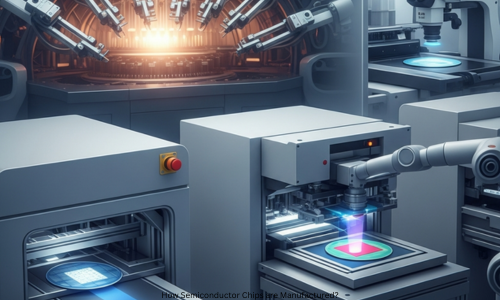
How Semiconductor Chips are manufactured? Have you ever thought about how that little chip in your phone or laptop comes to life? These chips are a driving force for most modern gadgets. They perform math, store information, and connect devices. And all this is on something the size of your fingernail. They are created with detail and exact work.
The Basics of Semiconductor Materials
At the heart of every chip lies silicon. This is derived from sand, a common element. It conducts electric current in certain ways. That fits it for transistors or the switches within electronics. Transistors provide the basis for logic paths.
Chip Manufacturing Process-Step by Step
Making chips is like building a little town: each piece adds its level, the paths of wires, and connects the whole. How Semiconductor Chips are manufactured?
Step 1: Purification of Silicon
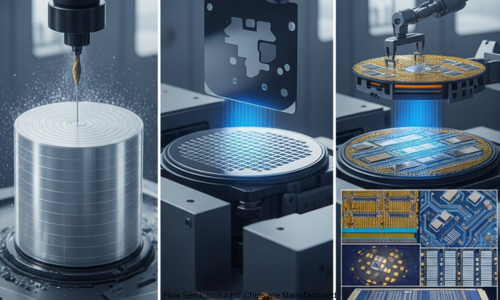
It starts with sand, quartz type full of silicon dioxide. Heat and chemicals strip the oxygen. Pure silicon remains. They melt this silicon, cool it slow, and it forms into one crystal rod called an ingot. Purity hits over 99.9999 percent. Small flaws could wreck the chip.
Step 2: Forming the Silicon Wafer
They cut the ingot into thin round slices. Each wafer measures one millimeter thick. Polishing makes them shine like glass. Smooth surfaces help etch fine circuits later. How Semiconductor Chips are manufactured?
Step 3: Designing the Circuit
First, the chip is planned by engineers for months. They use tools called Electronic Design Automation. These test billions of transistors and links. The final plan then turns into a mask for light printing.
Step 4: Photolithography
This is where the actual action begins: they coat the wafer with photoresist, which is light-sensitive stuff. Ultraviolet light passes through the mask with patterns. It prints the design on the wafer. How Semiconductor Chips are manufactured? Imagine sunlight casting shapes through a cutout, but here lines span only nanometers.
Step 5: Etching the Patterns
Next, the etching process clears extra material. Wet types are executed using liquids; dry ones use plasma gas. It shapes the narrow paths for electric flow.
Step 6: Doping (Adding Impurities)
Doping sounds weird, but it is very important. They mix bits of phosphorus or boron into silicon. That shifts how it handles current. Some places conduct well; others block it. How Semiconductor Chips are manufactured? Transistors arise this way, flipping on and off for data tasks.
Step 7: Layering and Depositing Materials
Chips stack many layers now, up to 100 or more. These hold insulators to split paths. Conductors like copper carry signals. Semiconductors build the switches. How Semiconductor Chips are manufactured? They add, shape, and cut each layer. This process repeats to form the chip’s 3D build.
Step 8: Testing and Quality Control
Wafers undergo checks before further processing. Machines fitted with lasers and scopes detect defects smaller than dust. One mark or speck might kill millions of switches. So, accuracy rules all. How Semiconductor Chips are manufactured?
Step 9: Packaging and Final Assembly
Good chips get laser-cut from the wafer. Each goes into a case for protection. Pins or pads link it to boards in phones or computers. This protects against heat, dirt, and moisture. Allows the chip to be connected and function.
Inside a Modern Chip Factory (Fab)
Chip plants, or fabs, rank as the cleanest spots on Earth. Workers suit up head to toe in bunny gear. Not a hair or speck touches the wafers. Filters purify air around the clock. Robots move wafers in precise motions. Cleaner than an operation theater. How Semiconductor Chips are manufactured?
The Scale of Miniaturization
Chips use nanometers-a billionth of a meter. New ones pack 3nm transistors or less. Billions squeeze into one chip. Smaller switches mean faster work, less heat, and lower power consumption. That’s why your phone gets better every year.
Environmental and Economic Aspects
Chip production is very expensive. One top fab runs over $20 billion. It drinks millions of gallons of pure water each day. Taiwan, South Korea, and the US are leading in output. Leading firms include TSMC, Samsung, and Intel. Green pushes add solar power and reuse plans. How Semiconductor Chips are manufactured?
The Future of Semiconductor Manufacturing
Tech grows, new stuff appears. Graphene, gallium nitride speed up chips; extreme ultraviolet light prints smaller bits. AI Designs Chips Better. Quantum Technology Tests New Edges. Semiconductors are heading toward quick, smart, and fresh ideas.
Conclusion
This is the path through which sand turns into mighty processors. It’s full of wonder: your phone, your car, everything depends on it. Physics, chemistry, fine skills blend here. Next time you power up your device, remember that sand start. How Semiconductor Chips are manufactured?
FAQs
Q1: How long does it take to make a semiconductor chip?
It’s 12 to 20 weeks for a full run. It depends on design and plant size.
Q2: Which country makes the most chips?
Taiwan leads the list, followed by South Korea, China, and the US.
Q3: What’s the difference between CPU and semiconductor?
Semiconductor means the base stuff like silicon. A CPU is one chip type that crunches data.
Q4: Why does it cost so much to make chips?
Ultra-sharp tools, clean spaces, and tiny scales demand billions.
Q5: What if one step in the process goes wrong?
One mistake can scrap an entire chip. Each portion is guarded by checks.
1 thought on “How Semiconductor Chips are manufactured?”