

Best Cloud Platforms for IoT Development in 2026. You did it. You built a smart device. Your prototype blinks, senses data, and runs great on the bench. It has a brain a microcontroller. It has senses sensors. It might even act with actuators. But now it sits alone. It is a thing. It lacks the key part: the internet. Now connect it to the cloud to unlock its full power. It requires a backbone to transmit the data, a central brain to process it, and a method to communicate with the users. IoT Cloud Platform does that job.
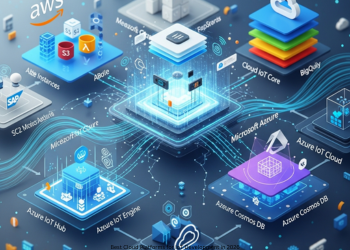
Cloud platforms are a bit like a busy city where the tall buildings pop up everywhere, named AWS, Azure, Google Cloud, Blynk, and Particle. They tout power, growth, and safety. But which one fits you? This choice shapes the costs, build speed, and room to grow. It goes beyond tech. This guide maps out the city. We cover top cloud platforms for IoT work, cover the industry leaders and quick starters, and show how to pick the right base for your linked world. Best Cloud Platforms for IoT Development in 2026.
Part 1: What to Seek in an IoT Cloud Platform?
First, we need to know the rules before ranking the players. Top platforms shine in key spots. Use these for a check:
- Device Links and Control: Do devices connect easily? Does it support MQTT-the best protocol for IoT-or HTTPS? Can you configure, monitor and observe one device or a million?
- Data Handling and Insights: What happens next with the data? The pre-processing involves ingestion, aggregation, and propagation of large volumes of data. Can it initiate processes based on the data? Is it performing deep analyses for critical information?
- Safety: No skips here. It needs full safety. Device checks block outsiders’ entry. Data locks during transmission in motion and at storage. User rights control.
- Growth Power: It has to scale with you. From ten devices in tests to ten million worldwide. No strain.
- Links to Other Tools: IoT data shines when there are links to other systems. Does it plug into databases, AI tools, reports apps, or outside software?
- App Building Assistance: How to create user apps? Does it have tools for web screens and phone apps?
- Costs: What is the pricing scheme? Per device, per message, per compute time, or a mix? Fees must be transparent and suit your setup.
Keep these in mind. Now we check top picks: they split into two groups, Big Scale Providers and Quick App Builders. Best Cloud Platforms for IoT Development in 2026.
Part 2: The Giants The Big Three Scale Providers
Cloud kings rule here: huge power, options, and tools. Less one product, more Lego blocks to build what you want.
1. AWS IoT Core (Top Dog)
AWS leads cloud space, and its IoT tools top that list for depth.
What it does: AWS IoT Core gates devices to Amazon’s big world. Not one tool, a full set for all the steps in IoT.
Key Wins:
- Huge Tool Set: Best of all. Data flows into more than 200 Amazon services. Save in S3. Process with Lambda. Stream via Kinesis. Check with QuickSight. Build AI in SageMaker. Options never end.
- Scale and Trust: Runs on tech powering Amazon.com. Growth proven.
- Strong Safety: Fine-grained device certs. Tight access rules.
Things to Note:
- Hard for Newbies: Many services puzzle beginners. Consoles look like mazes. Intelligent setup does need some know-how.
- Fees: Free start helps. But big scale bills mix connectivity, rules, data moves, more. Hard to guess.
- Best Match: Companies poised to scale big. Require strong cloud integrations. Have a team to handle complex configurations. Best Cloud Platforms for IoT Development in 2026.
2. Microsoft Azure IoT Hub Business Pick
Azure competes head-on with AWS. Powerful IoT functionality for large companies and factories.
What it does: Azure IoT Hub connects and operates millions of devices securely. Core of wider Azure IoT world.
Key Wins:
- Easy Microsoft Ties: If you use Office 365, Dynamics 365, and Power BI, everything works perfectly. Quickly send IoT data to business screens and apps.
- Digital Twin Tech: Building virtual copies of real spots, like factory floors or buildings, is a big win for factory IoT.
- Top Business Safety: Draws from years serving giant firms. Best Cloud Platforms for IoT Development in 2026.
Things to Note:
- Feels stiff for small teams; less fun for startups.
- IoT dev crowd smaller than AWS.
Best Match: Large enterprises dealing in Microsoft. Factory IoT jobs; projects with twin models.
3. Google Cloud Platform (Data and AI King)
Note: Google dropped its IoT Core. But Google Cloud still rocks IoT with a twist. They push partners and core data tools.
What it does: It combines top Google services. Devices hit Pub/Sub for incoming data. Then Cloud Functions process. BigQuery or Vertex AI for checks and AI. Best Cloud Platforms for IoT Development in 2026.
Key Wins:
- Best Data and AI: The strong point of Google. Nobody outperforms BigQuery stores, analytics, or easy AI in Vertex.
Things to Note:
- More Hands-On: No one-stop IoT tool. You build device setup, checks, safety—or pick partners. Not for new folks wanting simple.
IoT with big data needs. Aims in deep checks, machine learning, AI. Best Cloud Platforms for IoT Development in 2026.
Part 3: Quick App Platforms – For Fast and Easy Builds
These speed you from test to real product. They swap endless options for simple use.
Blynk (The Mobile App Leader)
What it is: Blynk is a popular IoT platform. It really shines in making the creation of sharp mobile applications to control your hardware very straightforward. Best Cloud Platforms for IoT Development in 2026.
Strengths:
- Simplicity: Drag and drop to construct professional-looking iOS and Android dashboards. No coding for an app is required.
- Speed: Go from new microcontroller to cloud-connected app in under an hour.
- Solid Free Plan: Great for hobbyists and early product tests.
Considerations:
It’s an app platform that skips deep backend control and tough data work. Best Cloud Platforms for IoT Development in 2026.
Best For: Hobbyists, students, artists, startups with app-first needs. Quickest path to proof-of-concept. Best Cloud Platforms for IoT Development in 2026.
Particle (The Smooth All-in-One Fix)
What it is: Particle sells matched hardware and software. The Wi-Fi and cellular microcontrollers pair tight with their trusty cloud.
Strengths:
- Perfect Match: They own hardware and software. So development flows easy and steady.
- Easy Cell IoT: Easiest start for cellular. They handle SIMs and plans.
- Top Reliability: Ready for real products. Many firms trust it.
Considerations:
- Stuck with Their Gear: Heavy tie to Particle hardware.
- Price: More per device compared to doing it yourself with large clouds.
- Best For: Businesses that need fast and solid products. Pay extra for less hassle and fast launch. Best Cloud Platforms for IoT Development in 2026.
Conclusion: Which Platform Wins? The Right One for You
No one platform rules all IoT clouds, so pick what fits your project. Cloud powers every IoT job from behind. Match it to your cash, time, skills, goals. You choose more than a service. You build your connected base. Best Cloud Platforms for IoT Development in 2026.
FAQs
Q1: What is an IoT cloud platform? Why get one?
It is an IoT gear cloud hub. Link devices safely to the net, grab and save data, check it. Build applications like phone or web tools to watch and run devices. Best Cloud Platforms for IoT Development in 2026.
Q2: Beginner or hobbyist? Easiest start?
Blynk tops for new folks, simple and quick. Drag-drop app in under an hour. Free plan fits personal work.
Q3: How does AWS IoT differ from Blynk?
AWS IoT, Azure, Google are tool kits. To build custom scale big, it is like Lego sets: strong but hard to learn.
App builders include Blynk and Particle. Fast products trade flex for ease.
Q4: Company wants big-scale product. What now?
Check top three big clouds:
AWS IoT Core: Top pick. Tons of tools, huge network. Good for most growth. IoT Azure Hub: Strong for big enterprises on Microsoft’s stack, like Office or Power BI. Great for work and industry. Best Cloud Platforms for IoT Development in 2026.
Q5: Need data checks and AI?
Google Cloud rocks data jobs: IoT Core is gone, but BigQuery and Vertex AI top analytics and smarts.
Q6: Platforms on hardware and cloud?
Yes. Particle leads. Their Wi-Fi/cell boards link smooth to their cloud. Easy, steady builds. Best for cell products.
Q7: Security concerns?
Big deal, yeah. All the important platforms lock down hard: device checks, data locks, user controls. Done right, safer than going it alone. Best Cloud Platforms for IoT Development in 2026.
1 thought on “Best Cloud Platforms for IoT Development in 2026”